
Dishwasher History: The Journey from Josephine Cochrane’s 1886 Invention to Modern, Quiet Models

Introduction
The dishwasher has come a long way from the hand-cranked wooden machines of the 19th century to today’s smart, ultra-quiet appliances designed for modern kitchens. What began as an attempt to reduce the time and labor of hand washing dishes evolved into one of the most important household innovations of the last century.
A major turning point came in 1886 when Josephine Cochrane patented the first practical dishwasher that used water pressure instead of manual scrubbing. Her invention revolutionized commercial kitchens and eventually paved the way for widespread household adoption.
Over the decades, dishwashers transformed from luxury appliances into everyday necessities through advancements in automation, sanitization, energy efficiency, and noise reduction. Modern models now feature intelligent sensors, flexible rack systems, advanced drying technology, and smart connectivity that make dishwashing faster, quieter, and more efficient than ever before.
Before the Dishwasher: Life Before Automated Dishwashing
In the mid-19th century, dishwashing was a grueling, manual chore that relied entirely on physical scrubbing and standing over wash bowls. Without the convenience of modern indoor plumbing or high-capacity water heaters, the process was slow and often viewed through a cultural lens that valued the visible effort of domestic work over the actual efficiency of the results. For many households, this meant hours of tedious labor every day, a task that became increasingly burdensome as the Industrial Revolution began to reshape societal roles.

Image Credit: Victorian London
The risk to delicate items was a primary driver for innovation, particularly among the social elite. Wealthy households frequently hosted elaborate dinner parties using heirloom china, only to find their precious collections chipped or broken by servants during the manual cleaning process. Even for the affluent, the lack of a reliable mechanical solution meant choosing between doing the work personally or risking their finest possessions to the wear and tear of hand-scrubbing. This specific challenge, protecting fragile dishware while achieving a sanitary clean, created a significant gap in the market for a more refined approach to kitchen management.
As the 19th century progressed, the industrial prowess of the era fueled a growing demand for labor-saving inventions that could modernize the home. While early mechanical attempts were often unreliable or too expensive for the general public, the societal shift toward efficiency and the eventual entry of more women into the workforce heightened the need for appliances that could reduce domestic drudgery. This environment set the stage for visionaries to bridge the gap between industrial-scale cleaning and the domestic kitchen, transforming a high-risk manual task into a standardized mechanical process.
The First Dishwasher Concepts (1850–1865)
Joel Houghton’s 1850 Wooden Machine
In 1850, the first major step toward modern kitchen convenience occurred when Joel Houghton secured the first U.S. patent for a mechanical dishwashing device. This early concept was a hand-cranked machine constructed primarily of wood. The design utilized a manual plumbing system that sprayed water onto dishes as the user turned a crank.
While Houghton's invention was a landmark in domestic engineering, it was far from the high-performance appliances we rely on today. The machine was notoriously slow and unreliable, lacking the power and efficiency needed to effectively remove stubborn food particles. Because it relied on manual labor to circulate water, it offered little actual relief from the physical demands of kitchen work.
L.A. Alexander’s Improved Rack System
Innovation in the field continued in 1865 when L.A. Alexander patented a refined version of the mechanical dishwasher. Alexander’s model was similar in operation to Houghton's hand-cranked design but introduced a critical advancement: a dedicated rack system. This allowed dishes to be organized and secured within the machine, representing an early precursor to the sophisticated loading layouts found in modern premium dishwashers.
Despite these technological improvements, these early designs were commercial failures and never achieved widespread acceptance. Beyond their lack of practical cleaning power, a significant hurdle was the 19th-century societal mindset that valued the visible effort put into housework over actual efficiency. Additionally, the lack of indoor plumbing and standardized water heating systems in most homes made these early machines more of a curiosity for the wealthy than a viable solution for the average household.
Josephine Cochrane Changes Kitchen History (1883–1898)
Why Josephine Cochrane Invented the Dishwasher
Josephine Cochrane, an affluent socialite from Shelbyville, Illinois, was driven to innovation by the frustration of seeing her fine heirloom china, purportedly dating back to the 1600s, chipped and damaged by servants during manual hand-washing. Coming from a family of engineers, she was naturally inclined toward a technological solution. When she realized no efficient machine existed, she famously vowed, “If nobody else is going to invent a dishwashing machine, I'll do it myself”.
The project shifted from a convenience to a financial necessity in 1883 following the death of her husband, William, which left her with significant debt and limited capital. Despite facing societal skepticism as a woman in a male-dominated field, Cochrane worked tirelessly in a woodshed behind her home to bring her vision to life. Her determination was not just about saving her dishes; it was about modernizing domestic labor and valuing the time of those performing it.

Image Credit: Click Americana
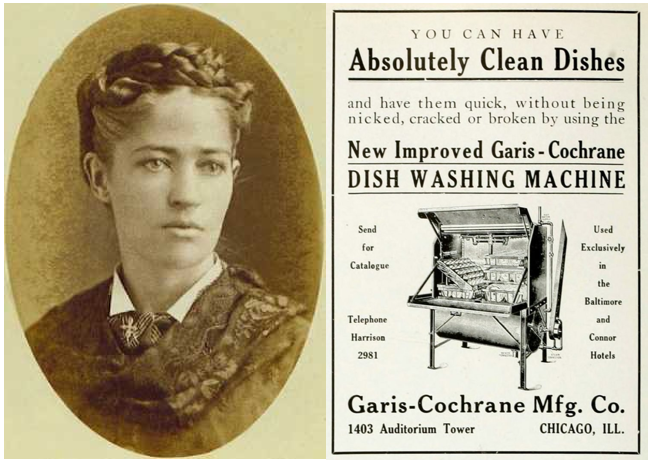
Image Credit: Messy Nessy Chic
The 1886 Patent That Changed Everything
On December 28, 1886, Cochrane received U.S. Patent No. 355,139 for her "Dish Washing Machine". This invention represented a massive leap in engineering because it was the first effective design to utilize water pressure rather than scrubbers or brushes to clean dishes. By eliminating physical contact with the cleaning mechanism, Cochrane successfully addressed the primary issue of dish breakage that had plagued earlier hand-cranked concepts.
The machine consisted of a copper boiler containing a wooden wheel that could be powered by a motor or hand-driven via a pulley. Within the machine, dishes were held securely in specifically fitted wire racks, a precursor to the rack systems found in every premium dishwasher today. This breakthrough in using pressurized hot soapy water ensured a more sanitary and efficient clean than anything previously available on the market.
Success at the 1893 Chicago World’s Fair
Cochrane’s invention achieved a major public breakthrough at the 1893 World’s Columbian Exposition in Chicago. Her "Garis-Cochran" machine stood out in Machinery Hall among iconic inventions like the telegraph and the phonograph, drawing admirers for its ability to clean and dry 200 dishes in just two minutes. The exposition’s judges were so impressed that they awarded her the highest prize for "best mechanical construction, durability, and adaptation to its line of work".

Image Credit: Bosch
This recognition provided the professional credibility Cochrane needed to break into the commercial sector. While domestic adoption was slow, elite hotels and restaurants, including Chicago’s Palmer House and Sherman House, began placing orders. The machine’s efficiency saved these institutions vast amounts of money by freeing staff from manual cleaning and meeting strict sanitation requirements, marking the true beginning of the commercial dishwashing industry.
Founding the Crescent Washing Machine Company
By 1898, Cochrane transitioned from an independent inventor to a manufacturer by opening her own factory and founding the Cochran’s Crescent Washing Machine Company. With George Butters as her manager, she expanded her reach significantly, selling dishwashers to hospitals, colleges, and businesses as far away as Mexico and Alaska. These early commercial models were highly regarded for their ability to wash and dry 240 dishes in two minutes.
Image Credit: Messy Nessy Chic
Although she offered domestic versions of her machine, they remained a luxury for the very wealthy, costing approximately $350, a sum far too high for average households that often lacked the plumbing and boiler capacity required to run them. Following Cochrane’s death in 1913, her company was eventually acquired by the Hobart Manufacturing Company in 1926. This acquisition would ultimately lead to the birth of the KitchenAid brand, which used Cochrane’s foundational patents to launch the first truly successful in-home dishwashers.
The Shift Toward Electric Dishwashers (1913–1950s)

Image Credit: Oldest Org
William Howard Livens and Modern Dishwasher Design
In 1924, William Howard Livens introduced a non-electric dishwasher in the United Kingdom that fundamentally changed the appliance's form factor. His design was the first to incorporate the layout elements we consider standard today: a front-loading door, wire racks to secure dishes, and a rotating water sprayer. By 1940, Livens further advanced the technology by adding dedicated drying elements to his machine. These innovations moved the industry away from Cochrane’s earlier "copper boiler" design toward a more practical domestic profile.
KitchenAid and the Rise of Household Dishwashers
The lineage of the modern premium dishwasher was solidified in 1926 when the Hobart Manufacturing Company acquired the Crescent Washing Machine Company. Hobart rebranded the technology, eventually using Josephine Cochrane’s foundational patents to launch the iconic KitchenAid brand. While early models were primarily commercial, KitchenAid hit a major milestone in 1949 with the launch of its first dishwasher specifically engineered for home use. This transition allowed the brand to apply industrial cleaning standards to the domestic kitchen, a philosophy that still defines the KitchenAid name today.
Image Credit: Ashton Renovations
Europe Enters the Market
While American designs were evolving, Europe saw its own significant technological leap in 1929 when Miele introduced the continent's first domestic dishwasher powered by an electric motor. This was a bold attempt to establish the dishwasher as a mass-market object in Europe, though it initially collided with the economic hardships of the Great Depression. Despite these early setbacks, the foundation was laid for a period of rapid appliance innovation overseas that would eventually lead to the high-efficiency European standards consumers recognize today.
Dishwashers as Luxury Appliances
Despite these major engineering breakthroughs, dishwashers remained a high-end luxury limited to wealthy households throughout the 1950s. The post-WWII economic boom provided the financial landscape for consumers to begin investing in major home appliances to reduce the burden of domestic labor. However, high costs were not the only barrier; many middle-class homes lacked the robust indoor plumbing and high-capacity water heaters required to run the machines effectively. It wasn't until these infrastructure and economic factors aligned in the following decades that the dishwasher truly began its journey toward becoming a household necessity.
Dishwashers Become Mainstream (1960–1987)
The mid-20th century marked a definitive turning point for kitchen technology as the dishwasher transitioned from a rare luxury to a standard feature in modern homes. This era of standardization and rapid innovation was led by major engineering breakthroughs that addressed consumer concerns regarding size, safety, and performance.
Bosch Enters the Market
The landscape of premium dishwashing changed significantly in 1964 when Bosch launched its first-ever dishwasher, the HSA household dishwasher. While the initial model featured a modest, foursquare design and simple functions, it established a foundation for high-performance German engineering in the home. The industry’s competitive power increased in 1967 when Bosch and Siemens merged their home appliance divisions to create BSH, a move that accelerated technological development and market penetration.
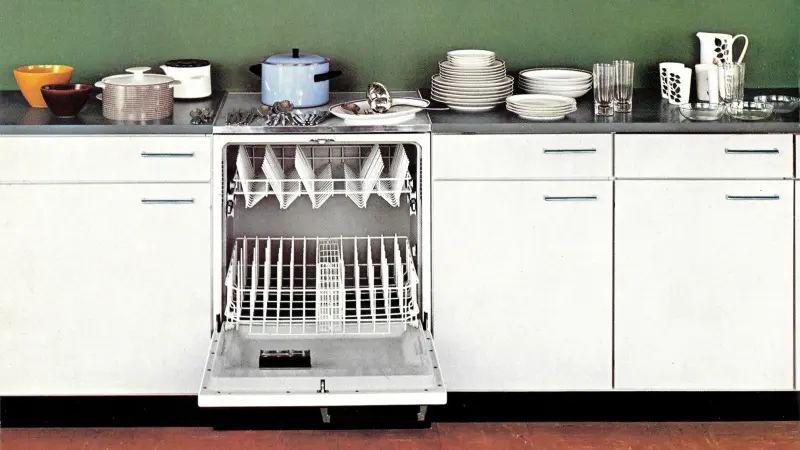
Image Credit: Bosch
Built-In Dishwashers Transform Kitchens
As the "fitted kitchen" trend gained popularity in the 1970s, the dishwasher's form factor underwent a radical redesign. In 1977, BSH presented the first under-the-counter (built-in) dishwasher, allowing the appliance to be seamlessly integrated into the cabinetry. By 1980, further innovation allowed these units to be equipped with matching furniture panels, establishing the sleek, "invisible" appliance look that many premium homeowners still prefer today.
Leak Protection and Compact Models
One of the most significant safety advancements in dishwasher history arrived in 1985 with the introduction of AquaStop. This specialized technology provided 100% protection against water damage, a breakthrough so successful that it became an industry standard within just one year. Recognizing the rise of smaller households and limited kitchen footprints, BSH also launched the first slim, 45 cm dishwasher in 1987, proving that high-end cleaning power could be delivered in a more compact, flexible package.
Advances in Dishwasher Detergents
The efficiency of the machine was matched by innovations in chemistry during the late 1980s. Before this time, early detergents often used pigments that could stain dishes or the appliance's interior. In 1987, chemist Dennis W. Weatherby and his team at Procter & Gamble patented a lemon-scented, non-staining detergent formula known as Cascade. This solution utilized dyes that remained stable in bleach-containing products, ensuring a thorough clean without the risk of discoloration.
Dishwashers Become Household Necessities
By the 1970s and 1980s, the dishwasher had officially moved beyond its status as an "expensive extravagance". The combination of improved indoor plumbing, higher-capacity water heaters, and the increasing number of women entering the workforce fueled a demand for labor-saving kitchen tools. In the United States and Germany, market penetration grew rapidly during this time, eventually reaching over 70% of households as consumers realized that machine washing was not only more convenient but also saved significant water and energy compared to hand-scrubbing.
The Era of Quiet, Efficient, and Smart Dishwashers (1990s–Present)
By the 1990s, dishwasher innovation expanded beyond cleaning performance alone. Manufacturers began focusing on quieter operation, lower utility consumption, improved sanitization, and smarter automation to meet the needs of modern households. These advancements transformed dishwashers from simple kitchen appliances into highly engineered systems designed for convenience, efficiency, and seamless integration into everyday life.
The Push for Energy and Water Efficiency
Growing environmental awareness in the 1990s pushed manufacturers to reduce water and electricity usage without sacrificing cleaning performance. Advanced soil sensors were introduced to detect food particles in the water and automatically adjust cycle length, temperature, and water usage based on load conditions.
Manufacturers also developed specialized wash zones to reduce unnecessary water consumption. In 1993, BSH introduced the Top Rack Only™ option, allowing smaller loads to be cleaned more efficiently. As technology improved, modern dishwashers reduced average water usage dramatically, with many models using only a fraction of the water required by older machines or hand washing.
The Race for Quieter Dishwashers
As open-concept kitchens became more common, reducing dishwasher noise became a major priority. Earlier models were known for loud motors, rattling dishes, and noticeable vibration, which became increasingly disruptive in homes where kitchens connected directly to living spaces.
To address this, manufacturers introduced suspended motor systems, multiple insulation layers, improved pump designs, and vibration-reduction technologies. By 2011, Bosch reached a major milestone with models operating at just 40 dBA, helping establish a new standard for ultra-quiet dishwashers. Premium models today operate quietly enough that many include floor-projected indicator lights to show when a cycle is running.
Sanitization and High-Temperature Cleaning
Improved sanitization became another major focus during the late 1990s. In 1997, Bosch introduced its Flow-Through Water Heater™, which safely heated water to sanitizing temperatures without exposing dishes to traditional heating coils.
These high-temperature wash systems allowed dishwashers to eliminate bacteria more effectively while improving drying performance. Modern sanitizing cycles are now commonly certified to remove 99.9% of bacteria, making dishwashers an important part of kitchen hygiene and food safety.
New Dishwasher Designs
Manufacturers also experimented with new layouts and loading systems to improve convenience and flexibility. In 1997, Fisher & Paykel introduced the first drawer dishwasher, allowing users to operate separate compartments independently for smaller or mixed loads.
Rack systems also became more adjustable and ergonomic. Features like RACKMATIC® gave users the ability to reposition upper racks even while loaded, creating more space for oversized cookware, stemware, and large dishes.
Smart and Connected Dishwashers
By the early 2000s, dishwashers began incorporating advanced automation and sensor-driven technology. Fully automatic systems could detect load size, soil levels, and water clarity to optimize cleaning performance with minimal user input.
Smart home integration accelerated this trend further. Connected dishwashers introduced app-based controls that allowed users to start cycles remotely, receive maintenance alerts, monitor detergent levels, and access customized wash programs through smartphone apps such as Home Connect.
Zeolith Drying Technology
Drying performance also improved significantly with the introduction of Zeolith technology in 2008. This system uses natural minerals to absorb moisture and release heat during the drying process, improving energy efficiency while delivering better drying results, especially for plastics.
Unlike traditional heated drying systems, Zeolith technology reduces residual moisture without relying solely on high heat, helping lower energy consumption while improving overall performance.
How Modern Dishwashers Compare to Early Models
Modern dishwashers are dramatically different from the hand-cranked wooden machines introduced during the 19th century. Early models required manual operation, offered inconsistent cleaning results, and produced significant noise during use. Today’s dishwashers rely on advanced sensors, automated spray systems, precision temperature controls, and specialized drying technologies to deliver efficient, high-performance cleaning with minimal effort.
Noise reduction has been one of the most noticeable improvements. Older dishwashers often operated above 60 dBA, while many premium modern models now function below 40 dBA. Water efficiency has also improved substantially, with modern systems using significantly less water per cycle while delivering stronger sanitization and drying performance.
The addition of smart technology, adjustable racks, leak protection systems, and specialized wash programs has further transformed the dishwasher into a highly adaptable appliance designed for modern kitchens and lifestyles.
| Feature | Early Dishwashers | Modern Dishwashers |
|---|---|---|
| Operation | Hand-cranked | Fully automatic |
| Noise Level | Loud | Near silent |
| Water Usage | High | Energy Star efficient |
| Drying | Air drying | Advanced heated drying |
| Connectivity | None | WiFi and app control |
Famous Dishwasher Brands That Shaped the Industry
Understanding the history of the dishwasher means looking at the powerhouse brands that took a niche luxury and turned it into a household essential. At ShopAppliances.com, we know that brand heritage is often a direct reflection of modern reliability. Here is how four iconic names shaped the industry we know today.
KitchenAid: The Direct Lineage of the Inventor
KitchenAid’s contribution to dishwashing is arguably the most prestigious, as it carries the torch of the original inventor, Josephine Cochrane. In 1926, the Hobart Manufacturing Company acquired Cochrane's "Crescent Washing Machine Company" and rebranded the technology to create the KitchenAid line.
By 1949, KitchenAid launched its first dishwasher engineered specifically for home use, bringing the high-pressure cleaning standards Cochrane had perfected for hotels into the domestic kitchen. Today, KitchenAid remains a leader by balancing that heavy-duty cleaning legacy with premium home aesthetics.

KitchenAid KDTS434SPS 24" Stainless Steel Fully Integrated Dishwasher | Shop Appliances
The KitchenAid KDTS434SPS offers flexible cleaning performance designed to handle everything from quick daily loads to heavily soiled cookware. With 5 wash cycles, users can easily customize each cycle based on the type of dishes being cleaned.
- 5 wash cycles for versatile cleaning options
- Quick wash and heavy-duty cycle selections
- Fully integrated controls for a seamless appearance
- Stainless steel finish for a modern kitchen design

KitchenAid KDTS424SJP 24" Green Fully Integrated Dishwasher | Shop Appliances
The KitchenAid KDTS424SJP combines premium cleaning performance with a unique green finish designed to stand out in modern kitchens. Its 5 wash cycles provide flexibility for both everyday dishes and heavier cleaning tasks.
- 5 wash cycles including quick and heavy-duty options
- Fully integrated controls for a streamlined look
- Flexible cleaning performance for different load types
- Distinctive green finish for a premium kitchen aesthetic
Bosch: Engineering the Standard for Silence and Safety
While many brands were focused solely on cleaning, Bosch entered the market in 1964 with the SA12 and immediately began solving the "lifestyle" problems of appliances. Their merger with Siemens in 1967 to form BSH accelerated their ability to innovate.
Bosch is responsible for several industry-standard safety and design features, including the first under-the-counter built-in dishwasher in 1977 and the revolutionary AquaStop leak protection system in 1985. Perhaps their greatest contribution is leading the "arms race" for quiet operation; in 2011, they set a massive milestone with the 800 Plus series, which operated at a near-silent 40 dBA, forever changing the expectation for open-concept kitchen appliances.

Bosch SHP65DM5N 500 Series 24" Stainless Steel Fully Integrated Dishwasher | Shop Appliances
The Bosch SHP65DM5N delivers powerful cleaning performance while maintaining exceptionally quiet operation at just 44 dBA. Designed for modern open-concept kitchens, this model combines advanced sound reduction technology with a sleek fully integrated design.
- Quiet 44 dBA operation
- Fully integrated controls for a seamless appearance
- Stainless steel tub for durability and improved drying
- Flexible loading options for everyday convenience

Bosch SHX78CM4N 800 Series 24" Black Stainless Steel Fully Integrated Dishwasher | Shop Appliances
The Bosch SHX78CM4N from the premium 800 Series combines ultra-quiet performance with advanced cleaning and drying technology. Operating at only 42 dBA, it is designed to run quietly enough for open living spaces while delivering high-end performance and modern styling.
- Ultra-quiet 42 dBA operation
- Premium black stainless steel finish
- Fully integrated controls for a streamlined look
- Advanced cleaning and drying performance
- Flexible rack system for larger cookware and delicate items
Miele: A Legacy of European Premium Innovation
Miele holds the distinction of introducing Europe's first domestic dishwasher powered by an electric motor in 1929. This move signaled the shift from manual labor to automation long before dishwashers were a common sight in middle-class homes.
Throughout the 20th century, Miele became synonymous with high-end European durability and precision. Notable contributions include the 1987 patent for the third-level cutlery tray, a feature that has since been adopted by almost every premium manufacturer in the world. Today, they continue to push the boundaries of quietude, with specialized programs claiming levels as low as 37 dBA.
Whirlpool: Bringing the Dishwasher to the Masses
Whirlpool’s historical impact is rooted in accessibility and market expansion. In 1986, Whirlpool acquired the KitchenAid brand, allowing them to offer a "good-better-best" tier of appliances to a wide range of consumers.
Whirlpool was instrumental in the mid-to-late 20th century push that saw dishwasher penetration in American homes jump from a luxury niche to over 75% adoption. Their focus on reliability and value-driven engineering helped transition the dishwasher from an "expensive extravagance" to a common necessity for the modern family.

Whirlpool WDP540HAMZ 24" Stainless Steel Fully Integrated Dishwasher | Shop Appliances
The Whirlpool WDP540HAMZ combines dependable cleaning performance with advanced filtration technology designed to keep dishes cleaner throughout the entire cycle. Its Triple Filtration Wash System uses multiple filter stages to capture food particles of different sizes, helping prevent debris from being redistributed onto dishes during washing.
- Triple Filtration Wash System for improved cleaning performance
- Fully integrated design for a streamlined kitchen appearance
- Stainless steel finish for a modern look
- Multiple wash cycles for everyday dishwashing needs

Whirlpool WDF332PAMS 24" Stainless Steel Full Console Dishwasher | Shop Appliances
The Whirlpool WDF332PAMS offers flexible cleaning options designed to handle everything from quick daily loads to heavily soiled cookware. With multiple cycle selections, users can customize performance based on the type of dishes being cleaned.
- Quick Wash cycle for faster cleaning
- Heavy Cycle for tough messes and cookware
- High Temperature Wash for enhanced sanitization
- Full console controls for easy operation
- Stainless steel finish for a clean, modern style
The Future of Dishwashers
The future of dishwashing is defined by deep integration into the smart home ecosystem, where appliances no longer just run cycles but actively adapt to household needs through AI-powered optimization. Modern systems already leverage advanced soil sensors and microprocessors to gauge load size and turbidity, automatically adjusting water pressure and temperature to ensure professional-grade results with zero guesswork. Looking ahead, the focus is shifting toward "updatable" appliances like the latest microprocessor-based generations, which allow homeowners to download new, specialized cycles for everything from heavy-duty cookware to delicate stemware, ensuring the machine evolves alongside consumer habits.
Sustainability remains the cornerstone of future innovation as manufacturers strive to meet aggressive energy and water conservation goals without sacrificing hygiene. Future engineering will likely expand on breakthroughs like Zeolith drying, which uses natural silicates to save energy, and specialized wash options that reduce water consumption by up to 30% for smaller loads. By combining these eco-friendly goals with seamless WiFi connectivity, enabling remote diagnostics and automatic alerts for detergent or rinse-aid levels, the dishwasher is transforming from a basic utility into a highly efficient, connected partner in modern kitchen management.
Conclusion
From Josephine Cochrane’s 1886 invention to today’s quiet, smart, and energy-efficient models, the dishwasher has transformed from a luxury machine into an essential modern kitchen appliance. Innovations in automation, water efficiency, sanitization, and noise reduction continue to shape the future of dishwashing technology.
Cochrane’s original idea revolutionized both home and commercial kitchens, paving the way for the advanced dishwashers we rely on today. As smart home technology continues to evolve, dishwashers will become even more connected, efficient, and convenient.
Discover the latest dishwashers from top brands like Bosch, KitchenAid, and Whirlpool at ShopAppliances.com.
- Quiet and energy-efficient models
- Smart and WiFi-connected dishwashers
- Built-in, compact, and premium options
- Competitive pricing and expert support
Shop today at ShopAppliances.com and upgrade your kitchen with modern dishwasher technology.
FAQs
Who invented the first dishwasher?
The first dishwasher patent was issued to Joel Houghton in 1850 for a hand-cranked wooden machine. However, Josephine Cochrane is widely credited with inventing the first practical dishwasher in 1886 because her design used water pressure to clean dishes effectively.
What made Josephine Cochrane’s dishwasher different?
Unlike earlier manual scrubber-style machines, Josephine Cochrane’s dishwasher used pressurized water to clean dishes automatically. Her invention improved cleaning performance, reduced damage to delicate china, and became the foundation for modern dishwasher technology.
When did dishwashers become common in homes?
Dishwashers became more common in households during the 1970s and 1980s. Earlier models were considered luxury appliances due to their high cost, but advancements in manufacturing and growing demand made them more affordable and accessible for everyday homes.
Which company made the first electric dishwasher?
Miele introduced Europe’s first electric domestic dishwasher in 1929. In the United States, KitchenAid became one of the leading companies to popularize electric dishwashers for home use during the mid-20th century.
What is considered a quiet dishwasher?
A dishwasher operating around 44 dBA or lower is generally considered quiet. Premium modern dishwashers from brands like Bosch and Miele can operate as quietly as 37 to 42 dBA, making them barely noticeable in most kitchens.
Why buy from ShopAppliances.com?
ShopAppliances.com is an authorized dealer offering genuine dishwashers from leading appliance brands, manufacturer-backed warranties, competitive pricing, reliable delivery options, and expert support to help you choose the right dishwasher for your kitchen.
Read More
The Post-War Boom: How the 1950s shaped the modern kitchen industry
Design Trends: Comparing 1950s Pastel Appliances to Modern Stainless Steel
From Icebox to AI: The 100-Year Evolution of the Refrigerator
The Evolution of the Kitchen Range: From wood-burning stoves to induction
Pet-Friendly Washer and Dryer Systems: How to Remove Pet Hair and Odors Effectively