
The History of the Washing Machine: How we moved from scrub boards to app-controlled laundry

Introduction
Laundry has come a long way from the days of washboards, river washing, and exhausting hours of manual scrubbing. What was once one of the most physically demanding household chores has evolved into a fully automated, app-controlled experience powered by smart technology and AI.
Over the centuries, washing machines transformed modern life by saving time, reducing labor, and improving household efficiency. From hand-cranked drums and early electric models to today’s Wi-Fi-enabled smart washers, each innovation helped shape the modern home and redefine everyday convenience.
This journey through washing machine history reveals how laundry technology evolved from physical labor to automation and finally into the intelligent, connected appliances we use today.
The Primitive Era: Laundry Before Machines
Before the advent of modern automation, laundry was widely regarded as "intolerable toil," a grueling weekly ordeal that required immense physical strength and significant time. For centuries, the process of cleaning garments relied on two fundamental mechanical principles: water flow and abrasion.
Washing clothes by rivers and communal washhouses
In ancient times, laundry was often a communal activity performed in rivers or public washhouses. This was not merely a chore but a social event that provided opportunities for community interaction and even matchmaking. One primitive yet effective method involved placing clothes in a large basket and securing it in a flowing stream, allowing the natural current to pull dirt through the fabric. In urban centers like ancient Rome, cleaners even utilized ammonia-rich urine as a primitive chemical cleansing agent.
Scrub boards and hand washing
The invention of the washboard in the 18th century marked a revolutionary step in manual cleaning. Early models from the 1840s were typically carved from single, large pieces of wood with corrugated rubbing surfaces. Because constant wetting caused these wooden boards to wear out quickly, they were eventually replaced by more durable materials including zinc-coated metal, brass, glass, and "granite ware" baked enamel. Despite these improvements, the process remained physically exhausting, often resulting in worn-out fabrics and "tired arms" for those performing the labor.
Boiling fabrics in cauldrons
For deep cleaning and sanitization, particularly of cotton and linen items like shirts and undergarments, clothes were often boiled in large metal cauldrons. While boiling was highly effective for sturdy, tightly woven goods, it was unsuitable for delicate items. Hand-knit socks and sweaters, for instance, could be ruined by high temperatures and instead had to be carefully sloshed in cold water and squeezed with extreme caution to avoid stretching the fibers.
Why laundry was considered one of the hardest household chores
The sheer volume of labor required made laundry the most demanding task in the pre-industrial home. In the early 1900s, an average household spent approximately 58 hours per week on domestic housework. Experts estimate that washing a single 17kg (37.5 lb) load of laundry by hand took roughly four hours. This labor-intensive process was not only time-consuming but also inefficient, often damaging the very garments being cleaned through excessive scrubbing and harsh manual handling.

Image Credit: Click Americana
Expert Maintenance Note: While we no longer rely on scrub boards, the principle of gentle care remains. When cleaning historical or premium brass accents on modern appliances, always avoid abrasive pads or steel wool. Instead, apply mild cleaners gently, allow them to sit briefly, then rinse and dry completely to preserve the finish without the "undue friction" of the primitive era.
The First Mechanical Innovations 1700s to 1800s
The 18th and 19th centuries marked the first major departure from the "intolerable toil" of manual laundry. As the Industrial Revolution took hold, inventors began filing the first patents for devices designed to replace the sheer physical force of hand-scrubbing with mechanical leverage and rotating motion.
Early Patents and Inventions
The quest for mechanical assistance began as early as the late 17th century. In 1691, the first English patent in the "Washing and Wringing Machines" category was issued to John Tyzacke for a general-purpose engine capable of washing cloth. By 1797, the United States followed suit when Nathaniel Briggs received one of the country's first washing machine patents. These early designs aimed to replicate the sloshing and abrasive action of hand-washing through levers and rocking boxes, such as John Shugert's 1843 "box-type" washer that used a lever to rock clothes through soapy water.
Henry Sidgier’s Rotating Drum Concept
The most significant leap toward modern appliance design occurred in 1782 when Henry Sidgier was granted a British patent for a rotating drum washer. Sidgier’s invention utilized a hand-crank to power a wooden barrel, creating a "Machine for washing wearing-apparel" that became the blueprint for the perforated cylinders used in every modern washing machine today. This shift toward rotation allowed for more consistent agitation without the "undue friction" that often damaged fabrics during hand-scrubbing.

Image Credit: Olde Wash
Hand-Cranked Washers
Throughout the 19th century, mechanical ingenuity refined the rotating drum. In 1851, James King patented a machine featuring a drum that began to resemble the modern front-loader. By 1874, the technology moved from industrial concepts into the home when William Blackstone built a domestic washing machine as a birthday gift for his wife. These machines were marketed specifically to save women from the "drudgery of housework," though they still required significant manual effort to turn the cranks and monitor the wash.
The Invention of Mangles and Wringers
Washing was only half the battle; drying wet, heavy fabrics remained a secondary ordeal. In 1774, Hugh Oxenham patented the mangle or wringer, a device consisting of heavy wooden rollers that used "considerable pressure" to squeeze excess water from clothing. For nearly 150 years, these hand-cranked rollers were the industry standard for water extraction. By the late 19th century, many manufacturers began offering "washing and mangling" machines that combined both functions into a single mechanical unit, representing the pinnacle of pre-electric laundry technology.
Did You Know?
The washboard, which reached its peak popularity during this era, eventually transcended the laundry room to become a percussion instrument. Its corrugated metal surface inspired musicians in early jazz and jug bands, proving that even a tool for "intolerable toil" could find a place in cultural history.
The Rise of Domestic Washing Machines
The mid-to-late 19th century represented a pivotal era in appliance history, marking the transition from grueling manual labor to the first mechanical aids designed specifically for the home. This period saw the washing machine evolve from an industrial curiosity into a cherished domestic companion, fundamentally reshaping the household landscape.
The Washboard Revolution: 1840s to 1890s
While often viewed as primitive today, the washboard was a high-tech advancement of the early 1800s. Early models from the 1840s were typically handcrafted from large pieces of wood, featuring labor-intensive corrugated rubbing surfaces. As domestic manufacturing improved, these evolved into more durable "premium" versions:
- Zinc and Brass: Introduced to prevent the rapid wood rot caused by constant wetting.
- Glass and Enamel: By the 1880s, "granite ware" baked enamel and glass surfaces were marketed for their superior durability and easier "glide" during the scrubbing process.

Image Credit: Click Americana

Image Credit: Pinterest
The Mechanical Pioneers: King and Smith
As the Industrial Revolution accelerated, engineers began applying mechanical principles to domestic chores. In 1851, James King patented a machine that featured a drum, which many historians consider the structural ancestor of the modern front-loader. Shortly after, in 1858, Hamilton Smith refined the rotary washing machine, making the mechanical action more effective and reliable for non-industrial users. These innovations shifted the focus from simple abrasion scrubbing to more efficient agitation.
Blackstone and the Birth of Home Convenience
The most significant cultural shift occurred in 1874 when William Blackstone, a merchant from Indiana, built a wooden washing machine as a birthday gift for his wife. Unlike previous mechanical designs that were often bulky or intended for commercial laundries, Blackstone’s machine was compact and user-friendly for the average home. This moment is widely cited as the birth of the domestic washing machine market, moving the device from a "tool of industry" to an "essential home appliance".

Image Credit: EBTH
Key Inventors & Their Legacy
| Inventor | Core Innovation | Impact on Modern Laundry |
|---|---|---|
| James King | The Internal Drum | Introduced the concept of a rotating cylinder to hold clothes, a design still used in front-loading machines today. |
| Hamilton Smith | Rotary Agitation | Developed effective rotary mechanisms that proved mechanical agitation was superior to hand-scrubbing. |
| William Blackstone | The Domestic Focus | Repackaged industrial technology into a consumer-friendly format, launching the home appliance industry. |
Electrification Changes Everything 1900 to 1930s
The transition from hand-cranked barrels to motor-driven machines was a pivotal shift in laundry technology. By leveraging the growing availability of electric motors, inventors sought to eliminate the physical burden of agitation and wringing that had defined housework for centuries.
The Thor Washing Machine 1907
The Thor is widely recognized as the first commercially successful electric clothes washer in the United States. Introduced by the Hurley Machine Company of Chicago, it represented a high-water mark for early 20th-century engineering.
- Design: The original model featured a wooden tub housing a perforated galvanized metal drum.
- Mechanics: Unlike manual models, the Thor used an electric motor to rotate the internal cylinder. A key innovation was its automatic reversing feature, which alternated the drum's direction to prevent clothes from tangling and ensure a more thorough clean.
- Market Positioning: Priced between $100 and $150, roughly $3,500 to $5,200 today, the Thor was initially a luxury item accessible only to affluent urban households with electrical service.
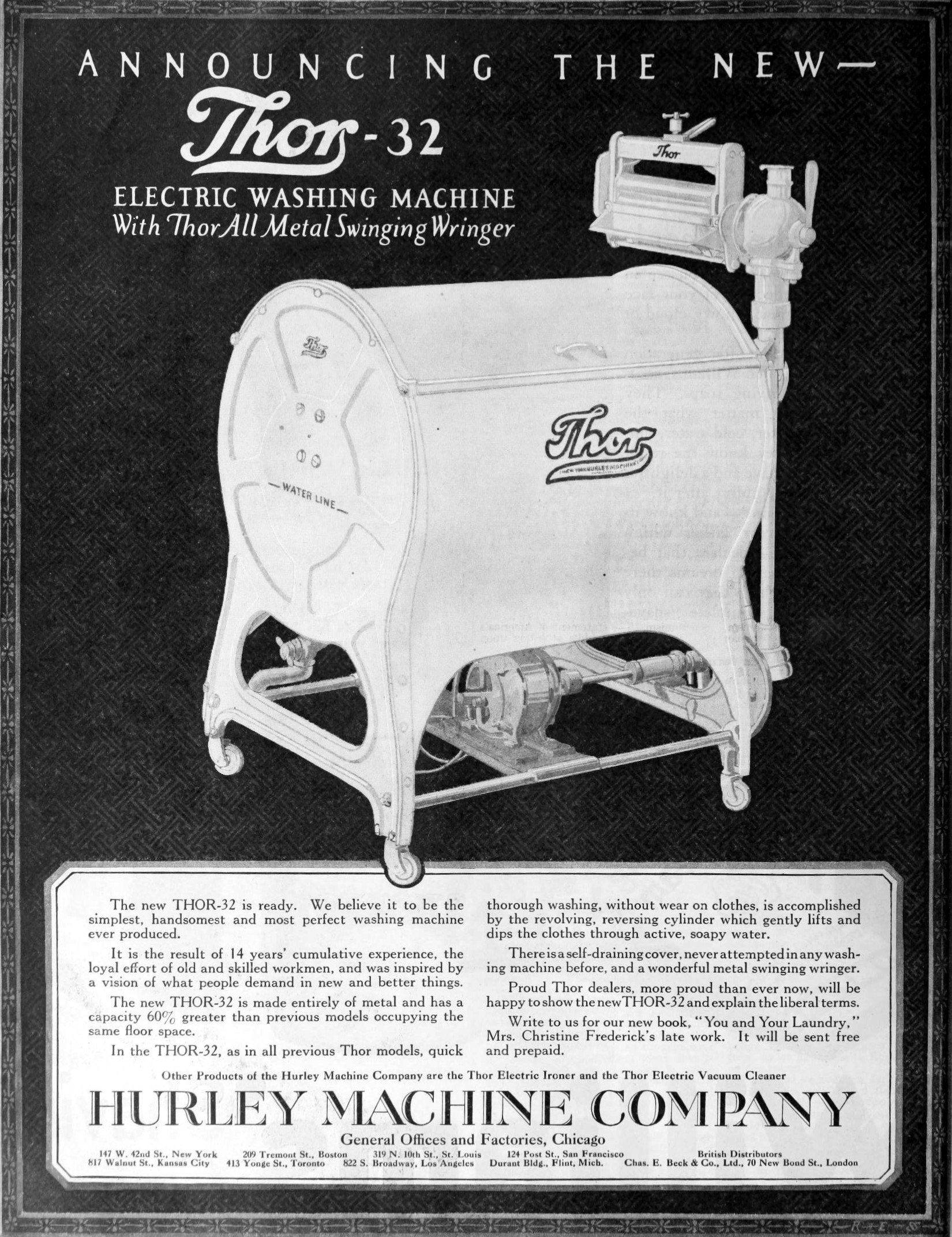
Image Credit: Wikipedia
Alva J. Fisher’s Contribution
American engineer Alva J. Fisher was the visionary behind the Thor’s drive mechanism. Joining the Hurley Machine Company around 1900, Fisher focused on streamlining domestic labor through automation. His patent U.S. Patent No. 966,677, granted in 1910, formalized the use of a motor-operated reversing cylinder, which became the foundational blueprint for modern drum-based washing. Fisher’s work effectively bridged the gap between manual mechanical washers and the automated technologies of the future.
Safety Concerns with Early Electric Washers
While revolutionary, early electric washers like the Thor were not without significant risks. Because the technology was in its infancy, early designs often prioritized function over user safety.
- Electrical Hazards: Early components were frequently non-watertight, leaving motors and wiring prone to short-circuiting and posing a high risk of electric shock to the user.
- Exposed Parts: Machines often featured exposed moving belts and pulleys. The attached wringers, used to squeeze water from wet clothes, required constant supervision to avoid clothing entanglement or physical injury.
Then vs. Now: The Electrification Leap
| Feature | The Thor 1907 | Modern Smart Washer |
|---|---|---|
| Power Source | Early DC/AC Electric Motor | High-Efficiency Digital Inverter |
| Tub Material | Wood and Galvanized Steel | Stainless Steel or Reinforced Polymer |
| Safety | Exposed belts; non-watertight | Fully enclosed; UL-certified waterproof electronics |
| User Input | Manual filling, soaping, and draining | Fully automatic with remote app control |
| Price Adjusted | ~$3,500 to $5,200 | ~$600 to $2,500 |
The First Step Toward "Clean Freedom"
The electrification of the washing machine was more than a technical achievement; it was a social catalyst. By reducing the time required for a load of laundry from four hours to under one hour, these early machines began the long process of liberating women from the 58-hour workweeks of domestic housework. This newfound efficiency paved the way for increased female participation in the labor force and higher education throughout the 20th century.
The Automatic Washing Machine Revolution
The arrival of the automatic washing machine marked a definitive boundary between the era of manual labor and the era of "clean freedom". By consolidating every step of the laundry process into a single, automated cycle, manufacturers transformed a grueling weekly ordeal into a background task of the modern home.
Bendix and the First Automatic Washer
In 1937, the laundry landscape changed forever with the introduction of the Bendix, the world’s first automatic washing machine. This "mythical" device closely resembled modern front-loaders, featuring an iconic glass porthole door, a rotating drum, and an electrically driven mechanical timer. For the first time, a single machine could autofill, wash, rinse, and spin-dry without manual intervention. However, early versions were so powerful that they lacked internal vibration dampers and had to be bolted securely to the floor to prevent them from "walking" during the spin cycle. Despite its high cost and lack of an internal water heater, the Bendix became an immediate landmark in appliance history, proving that technology could truly take the entire business of washing out of human hands.
Post-War Household Modernization: Pastel Dreams
Following World War II, the washing machine became a central symbol of household modernity and prosperity. As manufacturing resumed in the late 1940s, appliances began to reflect the optimistic aesthetic of the era. By the 1950s, the "white goods" market exploded with color, introducing pink, blue, and other pastel-colored machines designed to appeal to the mid-century desire for a stylish, coordinated kitchen. Marketing during this period leaned heavily into the idea of "emancipation," depicting stylish women effortlessly managing their homes thanks to these "miracle machines". This era also saw the debut of specialized innovations like the Tilt-a-Whirl agitator, which used a wobbling motion to mimic the gentleness of hand-washing while maintaining mechanical speed.

Image Credit: GE Appliances
Twin Tub Machines in Britain
While automatic machines were gaining a foothold in America, British consumers in the 1950s and 1960s embraced the twin tub as their primary step toward modernization. These units featured two separate tubs, one for washing and rinsing, and a second for spinning and draining. Although they were a "godsend" compared to hand-scrubbing, they remained labor-intensive, requiring the user to manually move wet, heavy laundry from one tub to the other using wooden tongs. Often not plumbed in, these machines required filling via hoses attached to kitchen taps and constant supervision to prevent overflows. Despite these disadvantages, their lower price point made them the first type of powered washer accepted by the British mass market.

Image Credit: GE Appliances
1970s Sophistication: From Timers to Computer Control
By the 1970s, the fully automatic machine had become the global industry standard, effectively rendering the twin tub and manual wringer obsolete. These machines featured integrated heating elements and sophisticated built-in timers that allowed for various fabric-specific cycles. The decade reached a technological pinnacle in 1976 when Servis launched the "Selectronic," the world’s first computer-controlled clothes washer. This move from mechanical dials to futuristic push-button controls paved the way for the sensor-heavy, high-efficiency appliances used today.
The Era of "Clean Freedom"
The transition to fully automatic laundry was more than a technical upgrade; it was a social revolution. Economists estimate that these advancements reduced the time spent on domestic housework from 58 hours per week in the early 1900s to just 18 hours by 1975. By liberating women from the "intolerable toil" of the washboard, the automatic washing machine served as a primary driver for increased female education and labor market participation throughout the 20th century.
The Digital & Smart Laundry Era
The transition from automatic machines to the "Smart Era" represents a fundamental lifestyle shift. Today’s laundry technology moves beyond simple mechanical cycles into the realm of the Internet of Things IoT and Artificial Intelligence AI, transforming a routine chore into a seamless, data-driven experience. Modern consumers no longer just seek clean clothes; they demand efficiency, sustainability, and convenience that integrates directly into their digital ecosystem.
IoT-Connected Washing Machines and App Controls
The hallmark of the modern era is Wi-Fi connectivity. Leading manufacturers have integrated IoT capabilities that allow users to manage their laundry through smartphone apps. This connectivity offers:
- Remote Operation: Users can start, pause, or monitor cycles from anywhere, allowing laundry to fit into a busy schedule rather than dictate it.
- Real-Time Notifications: Imagine a washing machine that texts your phone when the load is finished or a dryer that syncs with your digital calendar to ensure your clothes are ready for an upcoming meeting.
- Deep Integration: These appliances are increasingly designed to fit into broader "smart home" systems, communicating with other devices to optimize household energy and time.

Image Credit: Samsung
AI-Powered Fabric Detection and Customization
Artificial Intelligence has moved the washing machine from "preset guesses" to precision care. Advanced sensors and algorithms now analyze each load in real-time.
- Load Analysis: Sensors can detect not only the weight of a load but also the specific fabric type, distinguishing between rugged denims and delicate silks.
- Optimized Cycles: Once the fabric is identified, the AI suggests or automatically selects the ideal water level, temperature, and agitation speed. This level of customization ensures optimal fabric care, reducing wear and extending the lifespan of the garment.
Predictive Maintenance
One of the most significant shifts for the modern homeowner is the move from reactive repairs to predictive maintenance.
- Health Monitoring: Smart sensors constantly monitor the "health" of the appliance’s internal components.
- Proactive Alerts: Instead of discovering a breakdown after it happens, users receive smartphone alerts about potential issues before they lead to downtime. This reduces repair costs and extends the overall durability of the machine.
Energy-Efficient and Eco-Friendly Technology
Sustainability is a primary driver of modern innovation. High-efficiency HE machines utilize advanced algorithms and connected thermostats to minimize water and electricity usage.
- Resource Conservation: Modern washers are designed to use significantly less water than their automatic predecessors, appealing to the growing demographic of eco-conscious consumers.
- Sustainable Materials: Beyond the digital components, manufacturers are increasingly focusing on using sustainable materials in the construction of the machines themselves.
Modern Smart Washers Worth Considering
Choosing a high-performance machine today means balancing aesthetic design with cutting-edge functionality. Here are the key categories defining the current market:
Smart Front Load Washers
These models represent the pinnacle of fabric care and efficiency. Because the drum rotates on a horizontal axis, they use gravity to tumble clothes through the water, providing a thorough clean with less "undue friction". Modern versions feature sleek, minimalist designs that fit seamlessly into premium home interiors.

GE 4.8 cu. ft. Front Load Washer GFW550SSNWW | Shop Appliances
Stay connected to your laundry with built-in SmartHQ™ WiFi technology that lets you start, stop, and monitor cycles remotely from your smartphone. This front load washer also delivers efficient cleaning performance with advanced fabric care and modern convenience designed for busy households.

Bosch 2.4 cu. ft. Front Load Washer WGB24600UC | Shop Appliances
Designed for quiet, efficient performance, this Bosch smart front load washer features Home Connect™ technology for remote monitoring and control through your smartphone or tablet. Its compact design, energy-efficient operation, and advanced wash customization make it ideal for modern homes and apartments.
Energy-Efficient Washers
For the eco-conscious household, these machines prioritize minimizing the carbon footprint. Look for models that utilize digital inverter motors and advanced sensors to adjust resources precisely to the load size, ensuring no drop of water or watt of electricity is wasted.

Samsung 4.5 cu. ft. Front Load Washer WF45T6000AW | Shop Appliances
This ENERGY STAR® certified front load washer delivers efficient cleaning performance while helping reduce water and energy usage. With a spacious capacity and modern design, it’s built for households looking to save on utility costs without sacrificing washing power.

Electrolux 4.5 cu. ft. Front Load Washer ELFW7637AW | Shop Appliances
Recognized as an ENERGY STAR® Most Efficient product, this Electrolux front load washer combines powerful stain removal with exceptional energy efficiency. Advanced wash technology and gentle fabric care make it a smart choice for eco-conscious homes.
Wi-Fi-Enabled Laundry Systems
These systems offer the highest level of remote integration. Often sold as pairs washer and dryer, these systems communicate with each other to ensure the drying cycle is perfectly pre-set based on the wash cycle that just finished, all manageable through a single unified app.

LG 134191 Black Stainless Steel Front Load Set | Shop Appliances
This Wi-Fi-enabled LG laundry set brings smart convenience to your laundry routine with remote monitoring and control through the LG ThinQ® app. Its modern front load design, efficient performance, and connected features make managing laundry easier from virtually anywhere.

GE 176268 White Top Load Set | Shop Appliances
Featuring built-in SmartHQ™ Wi-Fi technology, this GE top load laundry set allows you to monitor and control wash cycles remotely for added flexibility and convenience. Designed for dependable everyday performance, it combines smart functionality with user-friendly operation.
How Washing Machines Changed Society
The transformation of the washing machine from a manual scrub board to a sophisticated, app-controlled appliance is not merely a story of mechanical progress; it is a narrative of profound social liberation. By automating the "intolerable toil" of hand-washing, this essential appliance fundamentally altered the trajectory of the 20th-century household and the global labor market.
The evolution of laundry technology represents a "dividing line" in history, moving society from a state of domestic drudgery to one of modern convenience.
The Reduction in Housework Hours
Before automation, laundry was a physically demanding weekly ordeal that consumed a significant portion of household time. Historical data indicates that the sheer efficiency of mechanical agitation provided a massive time windfall for families. By 1940, roughly 60% of electrified homes in the United States owned an electric washer, marking the beginning of the end for the four-hour laundry load.
Expert Insight: Early marketing often framed these machines as a means to save women from the "drudgery of housework," a positioning that highlights the appliance's role as a catalyst for social change.
The Impact on Women Entering the Workforce
The washing machine acted as a primary "engine of liberation," freeing up billions of labor hours that were previously locked in domestic production. Economists have identified a direct correlation between the "appliance boom" and the rise of women in the professional sphere.

Image Credit: Weebly
- Professional Growth: The reduction in domestic labor provided the necessary conditions for women to pursue higher education and career paths.
- Economic Parity: This shift contributed to an increase in women's earnings relative to men, fundamentally reshaping the economic landscape of the modern family.
Household Technology as Social Liberation
Owning a washing machine became a symbol of middle-class aspiration and inclusion in mainstream society. In the post-war era, the arrival of automatic and "pastel-colored" machines in the 1950s signaled a move toward a more aesthetic and leisure-focused lifestyle. This era of "clean freedom" allowed individuals to reintegrate into society more easily, as the burden of maintaining high standards of cleanliness was offloaded onto sophisticated machinery.
Key Statistics: The "Clean Freedom" Dividend
Housework Time Collapse
In the 1900s, an average household spent 58 hours per week on domestic work. By 1975, that number plummeted to just 18 hours.
The 17kg (37.5 lb) Efficiency Leap
Washing a 17kg (37.5 lb) load of laundry by hand originally took approximately 4 hours. Automated machines reduced that time to just 41 minutes, a sixfold reduction.
Workforce Participation
Technological progress in household appliances accounted for approximately 28 percentage points of the rise in female labor force participation between 1900 and 1980.
Voices of Innovation
"Takes the entire business of washing completely out of your hands." — 1954 Australian advertisement for the Bendix Deluxe.
"Hand gentleness—machine speed." — Hurley Machine Company slogan for the 1930s Tilt-a-Whirl agitator.
"A miracle of modern times." — Marketing description of the early automatic washing revolution.
Complete Washing Machine Timeline

Timeline graphic for washing machine history.
Conclusion
The washing machine has come a long way from washboards and hand scrubbing to today’s smart, AI-powered laundry systems. Modern washers now offer greater convenience, energy efficiency, and fabric care than ever before, turning one of history’s most time-consuming chores into a seamless everyday task.
Ready to Upgrade Your Laundry Room?
Shop the latest high-efficiency and smart washing machines at ShopAppliances.com and discover modern laundry technology built for today’s homes.
- Authorized dealer products
- Smart & energy-efficient options
- Fast delivery & expert support
Browse Washing Machines at ShopAppliances.com →
FAQs
Who invented the first electric washing machine?
Alva J. Fisher is widely credited with inventing the first commercially successful electric washing machine, the Thor, introduced around 1907.
What was the first automatic washing machine?
The Bendix, released in 1937, is considered the world’s first fully automatic washing machine.
Why were early electric washers dangerous?
Early models often had exposed motors and non-waterproof electrical components, creating risks of electric shock and mechanical injury.
What makes a washing machine “smart”?
Smart washing machines use Wi-Fi, sensors, and AI technology to allow remote control, automatic cycle adjustments, and maintenance alerts.
How did washing machines change society?
Washing machines dramatically reduced household labor and saved time, helping transform daily life and increasing workforce participation throughout the 20th century.
What is the difference between top-load and front-load machines?
Top-load washers are typically faster and easier to load, while front-load washers are known for better energy efficiency, gentler fabric care, and improved cleaning performance.
Why buy from ShopAppliances.com?
ShopAppliances.com is an authorized dealer offering genuine laundry appliances, manufacturer-backed warranties, competitive pricing, reliable delivery options, and expert support to help you choose the right washer for your home.
Read More
Dishwasher History: The Journey from Josephine Cochrane’s 1886 Invention to Modern, Quiet Models
The Post-War Boom: How the 1950s shaped the modern kitchen industry
Design Trends: Comparing 1950s Pastel Appliances to Modern Stainless Steel
From Icebox to AI: The 100-Year Evolution of the Refrigerator
The Evolution of the Kitchen Range: From wood-burning stoves to induction