
French Top vs Open Burner: Which Range Style Is Right for Your Kitchen?

When shopping for a professional-style range, one of the biggest decisions is choosing between a French top and open burners. While both deliver high-performance cooking, they operate in fundamentally different ways.
A French top is a solid metal cooking surface with a central heat source that creates gradual temperature zones, allowing you to move pans to control heat. Open burners, on the other hand, use exposed flames that deliver direct, high-intensity heat with immediate responsiveness.
These options tend to attract different types of cooks. French tops appeal to serious home chefs and entertainers who want to manage multiple dishes at once, while open burners are favored by those who prioritize power, speed, and precise flame control, similar to what you’d find in restaurant kitchens.
Ultimately, the choice comes down to how you cook:
Do you want versatility and multi-zone control, or maximum heat and instant responsiveness?
What Is a French Top?
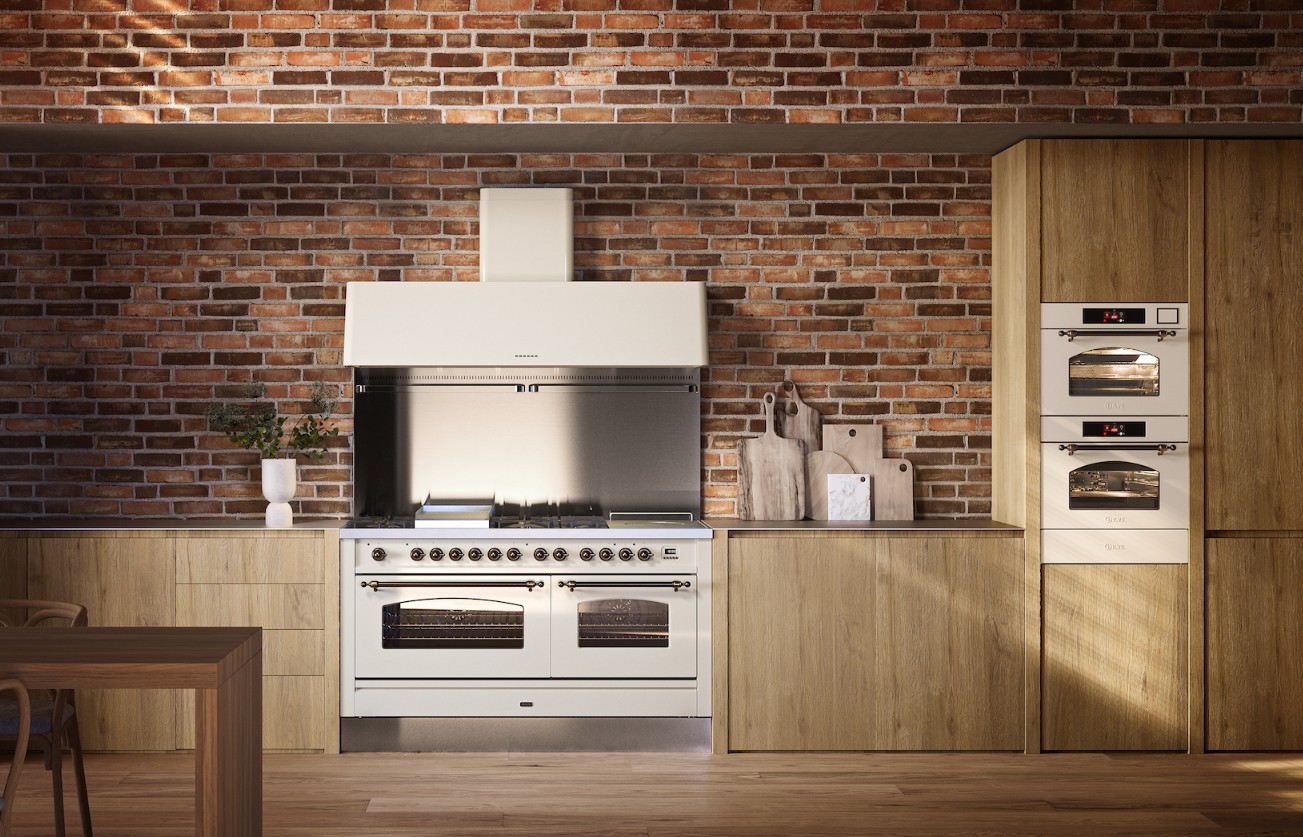
A French top is a large (typically 24" x 24") flat cooking surface, usually made of cast iron or rolled steel, with a high-powered gas burner located beneath a removable center ring.
How It Works
The French top operates using a single high-powered gas burner centered directly beneath a removable center ring in the metal plate.
- Indirect Heat: Unlike standard open burners that provide direct flame to a pan, the French top provides gentle, indirect heat through the heavy metal plate. This allows flavors to build and marry without excessive evaporation of liquids.
- Thermal Control: Because the surface is a solid plate, it requires a significant preheat time—typically 25 to 30 minutes—to allow the metal to reach a steady, thoroughly heated state.
- Nuanced Temperature Adjustment: Instead of turning a knob to adjust flame intensity, you control the heat by sliding pans across the surface to different zones.
The Heat Gradient
The primary feature of a French top is its graduated temperature zones, which allow for "multi-pot cooking" where several dishes can be prepared at different temperatures simultaneously.
Visual Gradient (The "Bulls-Eye" Design):
The surface often features concentric rings that act as thermal breaks, helping to distribute heat in a specific, predictable pattern.
- The Center (Hottest Point): Located directly above the burner, this area is ideal for searing meat, sautéing, or bringing large pots to a fast boil.
- The Middle Range (Medium Heat): Moving progressively away from the center, the temperature drops to a medium level. This zone is best for boiling or active simmering.
- The Edges and Corners (Coolest Points): The periphery provides the lowest temperatures, making it the perfect "simmering zone" for holding delicate sauces, melting chocolate or butter, and keeping prepared food warm until service.
By taking advantage of this gradient, a chef can manage an entire meal in one footprint, for example, searing a protein in the middle while simmering a sauce in the back corner and warming vegetables in a different corner.
What Is an Open Burner?
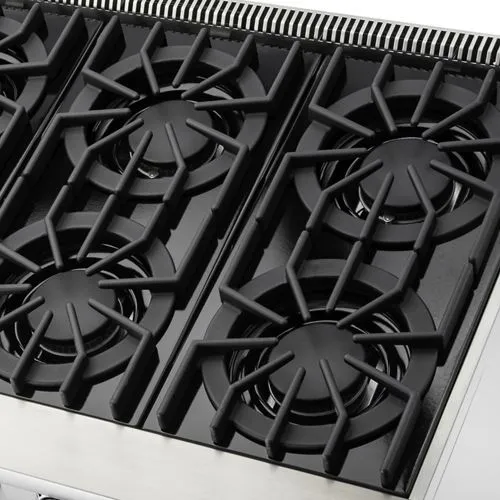
Open burners feature exposed flames that directly heat the cookware, with no protective seal between the flame and the cooking surface.
How It Works
- Direct Flame: Because there is no protective seal or cover between the flame and the cooking surface, the fire has direct contact with the bottom of the cookware. This provides an intense and immediate heat source.
- Maximum Airflow: The burner is not sealed underneath, which allows oxygen to flow freely around the burner head. This increased air circulation results in more efficient combustion, allowing the burner to reach much higher temperatures and boil liquids faster than sealed versions.
Why It Is Common in Pro Kitchens
Professional chefs prefer open burners because they offer performance capabilities that sealed burners cannot match:
- Superior Power: Open burners are capable of much higher BTU (British Thermal Unit) ratings. While standard sealed burners often top out at 15,000 BTUs, open burners can reach 22,000 to 25,000 BTUs, which is essential for professional-level searing and rapid boiling.
- Even Heat Distribution: Because oxygen flows freely, the flame pattern is typically wider and more even. This prevents "hot spots" in the center of the pan and ensures the entire cooking surface reaches the same temperature: a fact often demonstrated by the "flour test," where an open burner browns flour evenly across a pan while a sealed burner browns only the center.
- Exceptional Responsiveness: Direct contact with the flame allows for immediate temperature adjustments, providing the precision and timing required for delicate culinary techniques.
- Enhanced Simmering: Despite their high power, the large flame pattern and increased airflow actually provide more stable and precise control at very low settings, making them superior for simmering delicate sauces.
- Authentic Wok Cooking: Professional open burner grates often allow a round-bottomed wok to sit directly in the flame. This eliminates the need for a wok ring, which would otherwise lift the pan away from the heat and reduce cooking efficiency.
Key Differences Between French Top and Open Burner
| Feature | French Top | Open Burner |
|---|---|---|
| Heat Style | Radiant, indirect | Direct flame |
| Control Method | Move pan | Adjust flame |
| Preheat Time | Long | Instant |
| Max Heat | Moderate-high | Very high |
| Pan Capacity | High (5 to 6 pans) | Limited to burners |
| Learning Curve | High | Low |
| Cleaning | Surface maintenance | Deep cleaning required |
French Top Pros and Cons
Pros:
- Graduated Heat Zones: The center is the hottest point, with temperatures decreasing toward the edges. This allows you to boil in the middle, simmer in the "medium area," and keep food warm at the periphery simultaneously.
- Nuanced Temperature Control: Instead of adjusting burner knobs, you simply slide pans across the surface to find the desired heat level.
- High Pan Capacity: The large, flat surface can accommodate many pots and pans at once (often 5–6 medium saucepans), far more than individual burners in the same footprint.
- Versatility: It is ideal for complex meals requiring multiple pans at different temperatures, such as risotto. The center ring can also be removed for high-heat wok cooking.
- Indirect Heat: It provides a gentle, indirect heat that prevents excessive evaporation of liquids.
Cons:
- Significant Learning Curve: Mastering the different heat zones and the interactive style of cooking requires practice for those used to traditional burners.
- High Energy Usage and Heat: They are designed to stay on for long periods, leading to higher energy consumption and significant ambient heat in the kitchen.
- Long Preheat Time: It typically takes 10 to 30 minutes to heat the solid metal plate thoroughly before use.
- Cleaning Demands: The flat surface must be "seasoned" with oil like cast iron and cleaned regularly to prevent food debris buildup.
- Space and Cost: They are expensive, specialized components usually found only on large professional-style ranges (48" or 60") and take up the space of four standard burners.
Open Burner Pros and Cons
Pros:
- Exceptional Power: Open burners typically offer much higher BTU ratings than sealed burners (e.g., 22,000–25,000 BTUs vs. a typical 15,000 BTU cap for sealed units), allowing for faster boiling and professional-level searing.
- Superior Heat Distribution: Because oxygen flows freely around the burner, the flame is larger and more even. This prevents "hot spots" in the center of the pan and ensures the entire cooking surface reaches the same temperature.
- Maximum Responsiveness: The direct contact with the flame allows for immediate temperature adjustments, which is critical for delicate techniques or high-heat stir-frying.
- Effective Simmering: The larger flame pattern and increased airflow often provide more stable and precise control at very low settings than the small, concentrated flames of sealed simmer burners.
- Professional Wok Cooking: Many open burner grates allow a wok to sit directly in the flame without needing a separate wok ring, which would otherwise lift the pan away from the heat.
Cons:
- Difficult Cleanup: This is the primary disadvantage. Spills and food particles can fall directly into the burner components, requiring more extensive maintenance and disassembly for deep cleaning.
- Safety Hazards: The exposed flame poses a higher risk of accidental burns or fires, especially in homes with children or pets.
- Reduced Energy Efficiency: Because the flames are exposed, more heat dissipates into the surrounding air rather than being contained, which increases ambient kitchen heat and reduces overall efficiency.
- Visual Maintenance: If not cleaned properly, the exposed components can become permanently stained or corroded over time.
Best Use Cases: Which One Fits Your Cooking Style?
French Top is best for:
- Multi-pan cooking (sauces, risotto, reductions)
- Slow, controlled cooking
- Entertaining or batch cooking

ILVE UM48FSNR3SSC Majestic III 48" Stainless Steel Dual Fuel Range | Shop Appliances
Image Credit: Shop Appliances

ILVE UP60FSWMPWH Professional Plus II 60" White Dual Fuel Range | Shop Appliances
Image Credit: Shop Appliances
Open Burner is best for:
- High-heat cooking (steaks, stir fry)
- Precision control
- Fast-paced cooking

Viking VGIC53626BSS 5 Series 36" Stainless Steel Gas Range | Shop Appliances
Image Credit: Shop Appliances

Capital MCOR366L Classic Chef 36" Stainless Steel Gas Range | Shop Appliances
Image Credit: Shop Appliances
Performance Comparison: Heat, Control, and Efficiency
The performance comparison between French tops and open burners highlights a choice between graduated heat diffusion and direct high-powered combustion.
Heat Output and BTUs
- Open Burner: These burners are prized for their intense power and high BTU (British Thermal Unit) ratings. Pro-style units often reach 22,000 to 25,000 BTUs, allowing for professional-level searing and rapid boiling. Because they provide a direct flame to the cookware, they offer the fastest heat-up times for individual pans.
- French Top: The heat comes from a central burner located beneath a heavy steel or cast iron plate. Wolf models typically use a 15,000 BTU burner, while BlueStar units may use 18,000 BTUs. Rather than direct fire, it provides gentle, indirect heat that is diffused across the entire 24" x 24" surface.
Temperature Control Differences
- Open Burner: Control is handled traditionally through individual burner knobs, allowing for precise and responsive adjustments. The visual feedback of the flame provides immediate cues for temperature changes. These burners are also noted for effective simmering due to large flame patterns and high airflow.
- French Top: Control is physical rather than mechanical; once the unit is on, you slide pans across the surface to different heat zones. The center is the hottest for boiling, while the edges and corners provide lower temperatures for simmering or holding. This allows a chef to manage multiple pots at different temperatures simultaneously without ever touching a knob.
Energy Efficiency
- Open Burner: These are more efficient for quick, individual cooking tasks because they provide instant heat without a preheat period. However, because the flame is exposed, some heat is lost to the surrounding environment. The "open" design allows for superior airflow, which can lead to better combustion efficiency.
- French Top: These are significantly less efficient for single-meal preparation due to a long preheat time of 10 to 30 minutes required to saturate the metal plate. They are designed to remain heated for extended periods during professional service, which leads to higher overall energy consumption.
Kitchen Heat Impact
- Open Burner: These produce a notable amount of ambient heat in the kitchen because the flames are exposed and heat is not entirely contained by the cookware.
- French Top: The impact on kitchen temperature is much more substantial. Because the solid metal plate has high thermal mass and is designed to stay on for hours, it dumps an "incredible amount" of heat into the room. Professional users often describe the stations as getting exceptionally hot, necessitating a high-volume professional ventilation system and even external make-up air.
Cleaning and Maintenance Differences
- French top: seasoning, wiping, upkeep
- Open burner: disassembly, debris cleanup
Cost and Range Compatibility
Range Compatibility and Sizing
- French Top: These are typically found on larger professional ranges, specifically 48" or 60" models. They generally replaces four standard gas burners on the range top. While most are integrated into large ranges, some brands offer them on modular sections or even as separate 24" units.
- Open Burner: These burners are more widely available across standard professional range sizes, including 30", 36", 48", and 60" widths. On a 30" range, you will typically find four burners, while a 60" model can boast up to ten.
Price Differences
- Luxury Investment: A French top range is considered a luxurious splurge and often comes at a premium price point that reflects its specialized materials and custom-made nature.
Brand Availability
-
French Top Brands:
- ILVE: Known for Italian-made, customizable pro ranges, ILVE offers configurations that include French tops alongside high-powered burners.
-
Open Burner Brands:
- Viking: Offers the 7 Series line with professional open burners.
- Capital: Known for its Culinarian Series, Capital ranges feature true open burners with high BTU output, excellent heat distribution, and a strong reputation for restaurant-grade performance.
Final Takeaway: Cost and Compatibility
Choosing between a French top and open burners often comes down to space, budget, and cooking priorities.
A French top is a premium feature typically reserved for larger 48" or 60" ranges, making it a better fit for spacious kitchens and serious cooks who want a versatile, multi-zone cooking surface. Its higher cost reflects both its specialized design and professional-grade performance.
In contrast, open burners are far more flexible in terms of sizing and price. They are available across a wide range of configurations, making them easier to integrate into standard kitchen layouts while still delivering powerful, professional-level heat.
Bottom line:
- Choose a French top if you want a high-end, statement feature and have the space and budget to support it
- Choose open burners if you want powerful performance with more flexibility and accessibility
Final Thoughts: Which Should You Shop?
If you’re looking for a high-end, versatile cooking experience and love managing multiple dishes at once, a French top is a standout investment. It transforms your range into a dynamic cooking surface but requires more time, practice, and upkeep.
If your priority is power, speed, and precision, open burners are the more practical choice. They’re easier to integrate into different kitchen sizes and deliver the kind of performance most home cooks immediately appreciate.
Ready to Upgrade Your Kitchen?
Explore our full collection of French top and open burner ranges to find the perfect fit for your cooking style, kitchen layout, and budget. Whether you want a luxury centerpiece or a high-performance workhorse, there’s a pro-style range designed for you.
FAQs
Is a French top worth it for home use?
- Worth it if you cook often, enjoy hands-on techniques, and want a professional-style experience
- Not ideal if you prefer quick, low-maintenance, everyday cooking
Are open burners better than sealed burners?
Choosing between open and sealed burners is a common debate for those looking to invest in a professional-style gas range. The "better" choice depends entirely on your cooking priorities, whether you value raw power and precision or convenience and easy maintenance.
Can you use a wok on a French top?
Using a wok on a French top is a common question for those looking to maximize the versatility of this professional-style appliance. While possible, the technique depends heavily on your specific range model.
Which is easier to clean?
It depends on what kind of cleaning you prefer.
A French top is generally easier for daily maintenance because it has a single flat surface that can be wiped down quickly. However, it requires ongoing care like seasoning with oil to prevent rust, which some users find tedious over time.
Open burners, on the other hand, are more complex to clean. Spills can fall into the burner assembly, which may require disassembly and deeper cleaning. That said, many modern models include removable grease trays, which help simplify maintenance.